

Last Updated on 1 May 2026 by Adrienne
Fish in Portuguese Cuisine
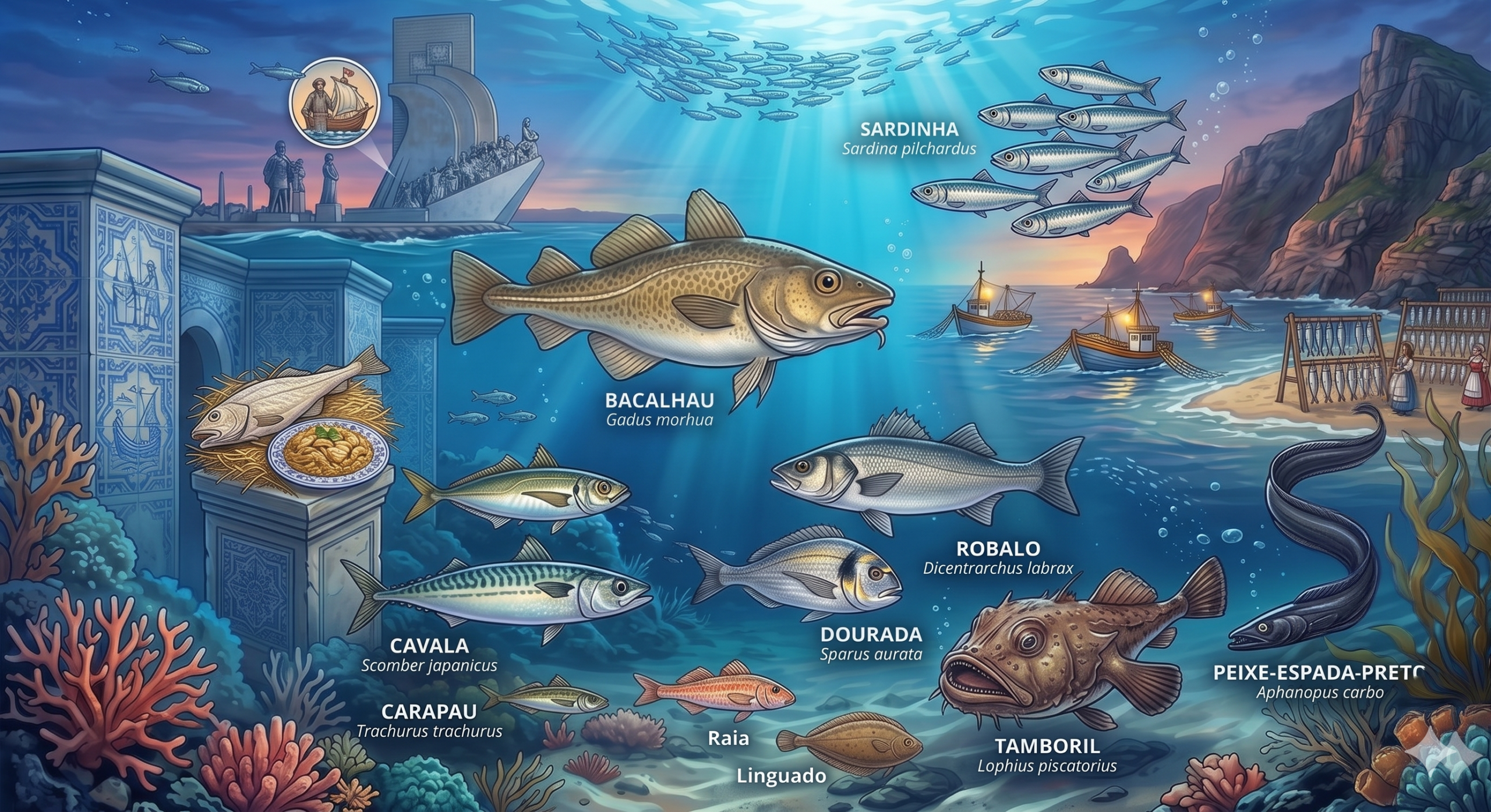
Portugal boasts the highest per capita seafood consumption in the European Union, at roughly 53.61 kg per person annually. The country’s extensive coastline and deep maritime history make fish a cornerstone of its diet. From the imported iconic salt cod to fresh seasonal catches, Portuguese fish are celebrated for their versatility and are often prepared using simple techniques—like charcoal grilling—to highlight their natural, briny flavours.
Bacalhau (Salted Cod):
Known affectionately as the “fiel amigo” (faithful friend), bacalhau is Portugal’s most treasured fish, despite the fact that it is not caught locally. The cod (Gadus morhua) is industrially fished in the cold waters of the North Atlantic and Norway, then imported in its dried, salted form. The tradition of salting fish dates back to the Roman Empire and became essential during the Portuguese Age of Discovery, providing a highly nutritious, non-perishable food source for long ocean voyages. It has firm, white flesh and a savoury, deeply umami flavour once properly rehydrated. Bacalhau must be soaked in water for several days to remove excess salt before it is boiled, baked, or fried. Culturally, it is the centrepiece of the Portuguese Christmas Eve dinner (Consoada), and it is famously said that there are over 1,000 ways to prepare it.
Must try: Bacalhau à Brás (shredded cod pan-fried with onions, thinly matched potatoes, and scrambled eggs) or Bacalhau com Natas (cod baked in a rich cream sauce).
Sardinha (Sardine):
Small, silvery, and packed with flavour, the European pilchard (Sardina pilchardus) is the undisputed queen of the Portuguese summer. Nutritionally, sardines are an incredible source of long-chain omega-3 fatty acids, calcium, and vitamin D. They are best enjoyed during the warmer months (traditionally May through August) when their fat content peaks, giving their tender flesh a rich, smoky flavour when cooked. They are the main event at summer festivals, especially in June during the Santos Populares (Popular Saints) celebrations in Lisbon and Porto.
Must try: Sardinhas assadas (whole sardines generously seasoned with coarse sea salt and grilled over an open charcoal flame), traditionally eaten right off a thick slice of bread with roasted peppers.
Carapau (Horse Mackerel) & Cavala (Chub Mackerel):
Fact Check: While often translated simply as mackerel, Carapau specifically refers to the Atlantic horse mackerel (Trachurus trachurus), whereas the standard Atlantic chub mackerel is known as Cavala.
Carapau is a slender fish with shiny skin and flaky, savoury flesh that is slightly less oily and intense than a sardine. Small, young carapaus are known as jaquinzinhos and are traditionally deep-fried whole. Carapau is also the star of a fascinating artisanal preservation culture in the coastal town of Nazaré. Here, local women dressed in traditional seven-layered skirts gut and suspend the fish on wooden racks directly on the beach to dry in the sun and Atlantic winds, creating carapau seco.
Must try: Carapau frito (fried horse mackerel) or Carapau de escabeche (mackerel marinated in a tangy vinegar, onion, and paprika sauce).
Robalo (Sea Bass) & Dourada (Gilthead Bream):
If you prefer a milder, delicate flavour, European Sea Bass (Robalo) and Gilthead Bream (Dourada) are the ultimate choices. Considered “noble fish” (peixe nobre) in Portuguese gastronomy, they both feature tender, buttery, and firm white flesh. Dourada (Sparus aurata) is easily recognised by the golden stripe between its eyes.
Must try: Both are best enjoyed in their purest form—served whole, charcoal-grilled (grelhado), and dressed simply with premium olive oil, a squeeze of lemon, and a side of boiled potatoes.
Tamboril (Monkfish):
Known scientifically as Lophius piscatorius, the monkfish has a disproportionately large head and a fearsome appearance, but its true value lies in its meat. The firm, sweet, and meaty tail flesh is remarkably similar in texture to lobster, earning it the nickname “poor man’s lobster”.
Must try: Arroz de Tamboril, a rich, brothy rice stew cooked with monkfish cubes, tomatoes, white wine, garlic, and fresh cilantro.
Peixe-Espada-Preto (Black Scabbardfish):
Endemic to the deep Atlantic waters surrounding the Madeira archipelago, the black scabbardfish (Aphanopus carbo) is an elongated, eel-like fish with black skin, large eyes, and sharp teeth. Despite its monstrous appearance, its white flesh is incredibly tender and mild.
Must try: Espada com banana, a highly traditional Madeiran dish where the fish fillets are breaded or battered, fried, and served alongside locally grown fried bananas.
Here are several more popular fish species to extend your list of Portuguese seafood:
Pescada (Hake):
Often considered a staple, everyday fish in Portugal, Pescada has a mild flavor and flaky white flesh. It is widely consumed and is famously the fish of choice on restaurant menus on Mondays when other fresh catches from the weekend are scarce.
Linguado (Sole):
This flatfish is highly prized for its delicate meat. Because it naturally has a very low fat content, Linguado is commonly pan-fried or grilled with butter, rather than just olive oil. Its thickness usually dictates whether it is served whole or as fillets.
Peixe Galo (John Dory):
Despite its unusual appearance—featuring a large head, spikes along its dorsal fin, and a prominent black spot on its side—the John Dory yields fantastic, delicate white fillets. According to folklore, the dark spot on its flank is the thumbprint of St. Peter.
Salmonete (Red Mullet): A small, reddish fish known for its intense and unique flavour. As a bottom feeder that sifts through the ocean floor, its wild diet heavily influences its rich, slightly sweet taste. It is considered a seasonal delicacy that is highly sought after during the winter months.
Raia (Skate or Ray):
Skate wings are highly appreciated in traditional Portuguese cooking. The flesh has a unique, slightly gelatinous texture and is an irreplaceable ingredient in stews. A classic regional preparation, especially in the Algarve town of Olhão, is Raia Alhada, a flavourful dish made with boiled skate, potatoes, vinegar, and generous amounts of crushed garlic.
Corvina (Croaker):
A large fish with firm, tasty white meat that is very adaptable to a variety of recipes. Corvina is a frequent star on weekday lunch counter specials across Portugal, offering a pleasant and accessible flavor for everyday dining.
Atum (Tuna):
While tuna is consumed globally, it has a strong presence in Portuguese cuisine, heavily fished in the Azores, Madeira, and the Algarve. It is enjoyed fresh as thick grilled steaks, but it is also a cornerstone of Portugal’s famous gourmet canned fish industry, where premium fillets are preserved in olive oil.