

Last Updated on 1 May 2026 by Adrienne
Crustaceans in Portuguese Cuisine
Crustaceans add a touch of luxury to Portuguese meals, prized for their sweet meat and vibrant presentation. Whether featured in humble coastal taverns or high-end marisqueiras (seafood restaurants), they are often cooked with minimal interference to let their natural oceanic flavors shine.
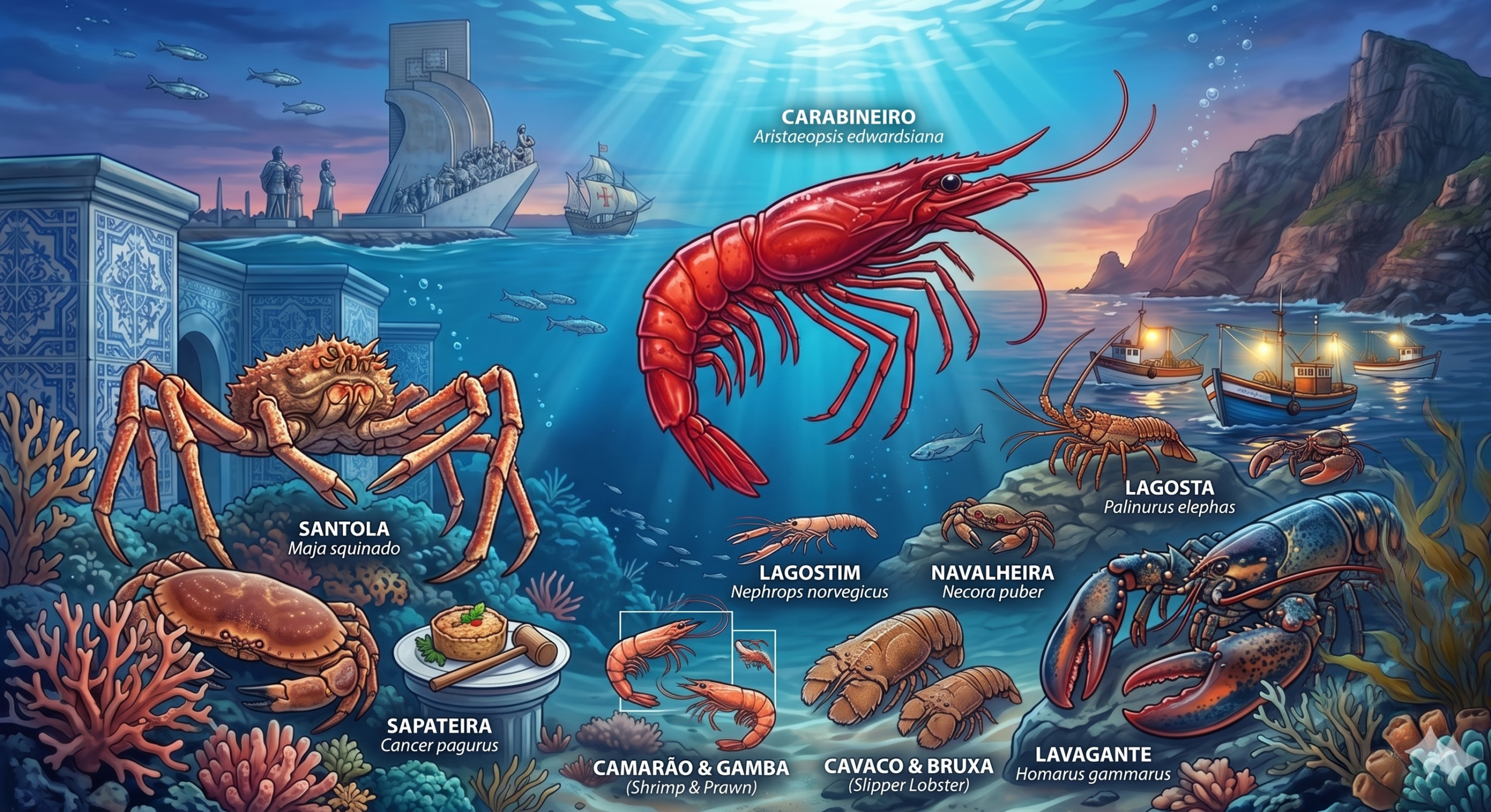
Camarão & Gamba (Shrimp & Prawn): Prawns and shrimp vary widely in size and are prized for their firm, succulent texture and sweet, delicate flavour. In Portuguese menus, you will often see a distinction between camarão (shrimp) and gamba (prawn). They are frequently cooked with their shells and heads intact to maximize flavour, particularly in dishes like Arroz de Marisco (seafood rice), where peeling them on your plate is considered part of the authentic experience. Grilled, boiled, or sautéed, they star in classics like camarão ao alhinho (garlic prawns) or camarão piri-piri. A standout premium species is the Carabineiro (Scarlet Prawn), a massive deep-sea prawn that retains its vibrant crimson colour even after cooking. It is renowned for its intense flavour, which is heavily concentrated in the head, and is often served simply grilled with coarse salt or even raw.
Note: While many people assume the difference between shrimp and prawn is purely based on size (with prawns/gambas generally thought to be larger), the true distinction is biological. The most noticeable difference is in their exoskeletons; the shell segments of a gamba do not overlap in the same way as those of a camarão, making the gamba slightly straighter and less prone to curling up. Additionally, they differ in their anatomy: camarões (shrimp) have claws on two pairs of their legs, while gambas (prawns) have claws on three pairs.
Carabineiro (Scarlet Prawn): These are deep-sea prawns known for their massive size and vibrant, intense crimson colour that, uniquely, remains bright red even after cooking. Carabineiros have a robust, distinctly sweet flavour that outshines standard shrimp, with much of their prized flavour concentrated in the head. Because of their premium quality, they are usually treated with immense respect in the kitchen—often simply grilled with coarse sea salt or eaten raw to let their natural taste take centre stage.
Sapateira (Brown Crab): The edible brown crab, or sapateira, has a hard, oval shell and yields two distinct types of meat: the sweet white meat from the claws and legs, and the rich, creamy brown meat from the body. In Portugal, this brown meat is incredibly popular and forms the base for Sapateira Recheada (Stuffed Crab). The crab’s shell is hollowed out and refilled with a chilled, savory paté made by mixing the crab’s own body meat with mayonnaise, mustard, chopped hard-boiled egg, capers or pickles, and a splash of beer to loosen the mixture and balance the richness. It is traditionally enjoyed scooped onto toasted bread or crackers.
Santola (Spider Crab): Not to be confused with the brown crab, the European spider crab (santola) features a rounder, spiky, heart-shaped shell and long, thin spidery legs. Extracting the meat requires a bit of effort—often involving a small wooden hammer at the table—but it is incredibly delicate and sweet. Like the sapateira, it is famously used to make a stuffed shell paté (santola recheada), or the regional specialty santola no carro, which mixes the crab meat with cornbread (broa), onions, spices, and port wine.
Lagosta (Spiny Lobster) vs. Lavagante (European Lobster): Portugal offers two distinct, premium lobsters that are strictly differentiated in local gastronomy. Lagosta refers to the spiny lobster, which lacks large front claws (pincers) and has long, heavy antennae. Thanks to the cold Atlantic waters, its meat is exceptionally sweet, featuring heavily in regional dishes like lagosta suada (slowly steamed lobster) from Peniche. Conversely, Lavagante is the European clawed lobster, recognized by its large pincers and darker, bluish-black shell that turns bright red only when cooked. Lavagante is generally the pricier of the two, boasting a firmer, fleshier bite, and is often the star of a luxurious Arroz de Lavagante (lobster rice).
Navalheira (Velvet Crab): These small swimming crabs are distinguished by the fine hairs covering their shells, giving them a velvety appearance, and their bright red eyes, which sometimes earn them the nickname “devil crabs”. Though small, navalheiras are highly sought after by seafood lovers because their meat is incredibly sweet and velvety. They are typically served with minimal fuss, simply boiled in salted water with a bay leaf.
Cavaco & Bruxa (Slipper Lobster): These bizarre-looking, flat, armored crustaceans lack claws and defensive spines, but conceal incredibly tender and flavorful meat. The larger Cavaco (Mediterranean slipper lobster) is quite rare and expensive, most commonly found boiled or grilled in the Azores archipelago. A smaller relative, affectionately known as Bruxa (witch) or Santiaguinho, is often enjoyed deep-fried and served with mayonnaise in the coastal towns around Lisbon and Cascais.
Lagostim (Langoustine / Scampi): Resembling a miniature, slender, coral-coloured lobster, the lagostim offers incredibly delicate and slightly sweet white meat in its tail. In Portuguese seafood restaurants, they are highly appreciated and are usually eaten simply boiled to preserve their refined flavour profile.