

Last Updated on 16 July 2026 by Adrienne
If you’ve recently moved to Portugal or are just trying to bake a familiar recipe in a Portuguese kitchen, you’ve probably stared at the supermarket baking aisle in confusion. Instead of clearly labeled “All-Purpose,” “Cake,” or “Bread” flour, you are greeted with bags stamped with mysterious numbers: Tipo 45, Tipo 55, Tipo 65.
What do these numbers mean, and which one should you use for your chocolate chip cookies or Sunday morning pancakes?
Don’t worry—Portuguese flour isn’t a secret code. It’s actually a highly logical system once you know how it works. Here is everything you need to know to bake with confidence in Portugal.
What Does “Tipo” Mean?
In Portugal (as well as France and several other European countries), flour is categorized by its ash content.
When a laboratory tests a batch of flour, they burn a small sample at a very high temperature. The starches and proteins burn away, but the minerals remain as ash. Because a wheat kernel’s minerals are concentrated in its outer layer (the bran) and the germ, the amount of ash left behind tells you exactly how much of the whole grain is in the flour.
- Low Numbers (e.g., 45, 55): These are highly refined, pure white flours. Almost all the bran and germ have been removed. They are lighter and softer.
- High Numbers (e.g., 65, 150): These are less refined. They retain more of the bran, giving the flour a darker color, more nutrients, stronger gluten structure, and a wheat-forward flavor.
The Ultimate Wheat Flour Cheat Sheet (Farinha de Trigo)
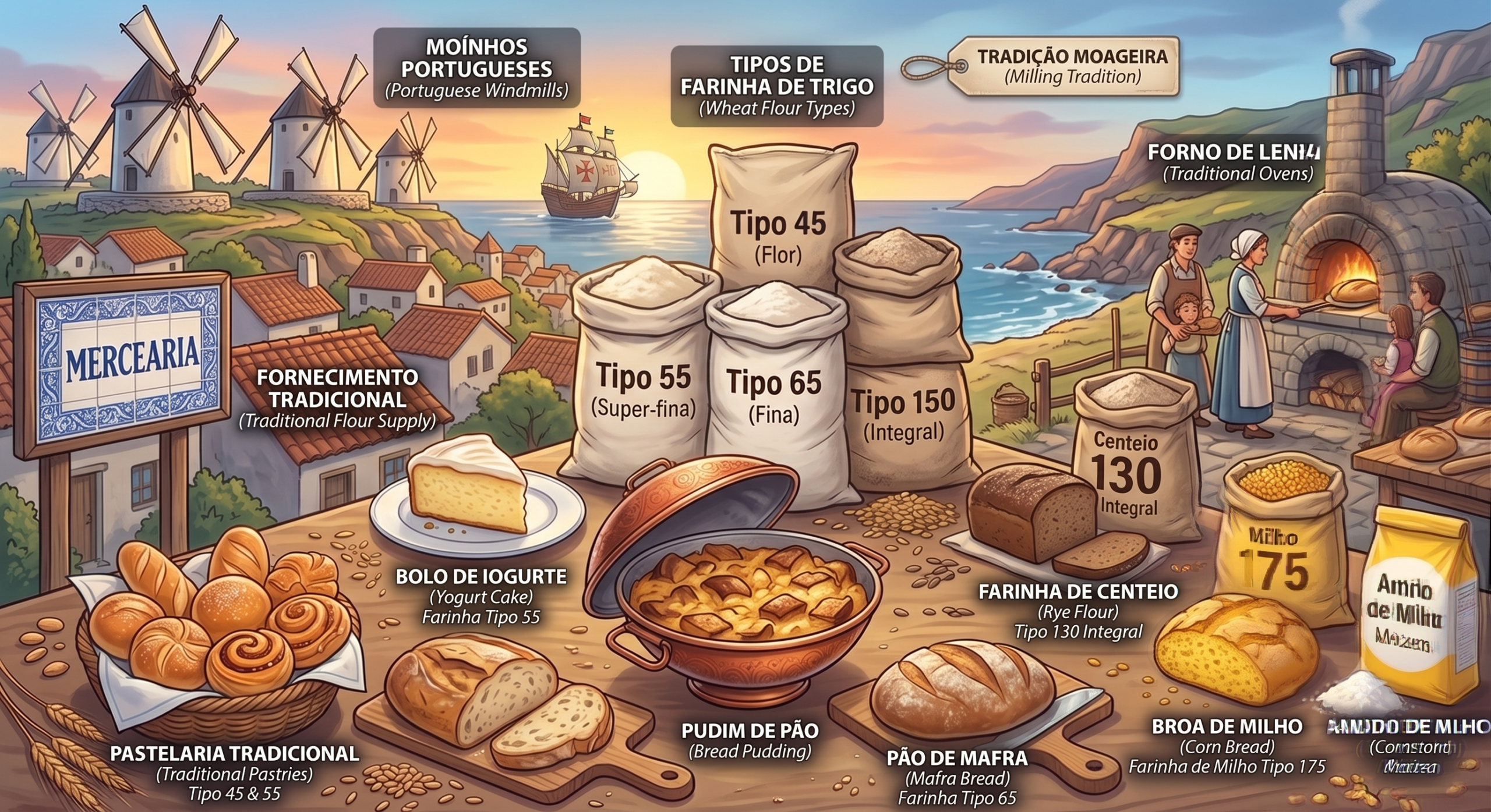
Here is a breakdown of the standard wheat flours you will find in any Pingo Doce, Continente, or local mercearia, and what to use them for.
Tipo 45 (Farinha Flor)
The Equivalent: Cake / Pastry Flour This is the finest, whitest, and softest flour available. It has a lower protein content, which means it develops less gluten.
- Best used for: Light, delicate bakes. Think sponge cakes, croissants, puff pastry, brioche, and fresh homemade pasta.
Tipo 55 (Farinha Super-Fina)
The Equivalent: All-Purpose / Plain Flour If you only want to keep one bag of flour in your pantry, make it Tipo 55. This is the workhorse of the Portuguese kitchen and the closest thing you will find to standard American or British all-purpose flour.
- Best used for: Almost everything! Everyday cakes, cookies, brownies, muffins, thickening sauces, and breading meats for frying.
Tipo 65 (Farinha Fina)
The Equivalent: Bread Flour / Strong Flour Despite the name “Fina” (fine), this flour has a higher protein content and retains slightly more of the wheat grain than Tipo 55. It develops a strong gluten network, giving structure and chewiness to baked goods.
- Best used for: Breads, pizza dough, yeast-leavened rolls, and traditional rustic Portuguese baking.
Tipo 80 & Tipo 110 (Farinha Semi-Integral)
The Equivalent: Light / Half Whole-Wheat Flour These are middle-ground flours. They aren’t purely white, but they aren’t fully whole-grain either. They offer a great compromise if you want the nutty flavor and fiber of whole wheat but need a lighter rise than a 100% whole grain loaf can provide.
- Best used for: Artisan sourdoughs, rustic country loaves, or blending 50/50 with white flour for a healthier sandwich bread.
Tipo 150 (Farinha Integral)
The Equivalent: Whole Wheat / Wholemeal Flour This is true whole grain flour, utilizing the entire wheat kernel. It is dense, heavy, and packed with nutrients and fiber.
- Best used for: 100% whole wheat breads, crackers, and rustic bakes. (Note: Because it is so heavy, many bakers mix it with Tipo 65 to help the bread rise).
What About Other Flours? (Rye & Corn)
Wheat isn’t the only grain in Portugal! Portuguese baking heavily relies on rye (centeio) and corn (milho), especially in the central and northern regions. These have their own numbering systems:
Farinha de Centeio (Rye Flour)
- Tipo 70: A light, sifted rye flour. Great for adding a mild tang to bread without making it heavy.
- Tipo 130 / Tipo 170: Dark, whole-grain rye flour. This is what you use to make dense, traditional rye loaves or a robust sourdough starter.
Farinha de Milho (Corn Flour)
- Tipo 70: Fine yellow corn flour.
- Tipo 175: Coarse, whole-grain corn flour. This is the star ingredient in Broa de Milho, the famous, dense Portuguese cornbread.
(Note: Portuguese “farinha de milho” is not the same as cornstarch. If you are looking for cornstarch to thicken a pudding or sauce, you need to buy Amido de Milho, often sold under the brand name Maizena).
One Last Tip: Look for “Fermento”
When buying Tipo 55 (All-Purpose) flour, pay close attention to the bottom of the bag. You will usually see one of two phrases:
- Com Fermento: Self-raising flour. This already has baking powder mixed into it. It’s highly popular in Portugal for making quick yogurt cakes (bolo de iogurte).
- Sem Fermento: Plain flour without any added leavening agents. If your recipe calls for adding baking powder or baking soda, make sure you buy this one!
Happy Baking! (Boas fornadas!)